Building drag and shielding in a realistic urban environment
Jingzi Huang, Omduth Coceal, Marco Placidi, Zheng-Tong Xie, Maarten van Reeuwijk
2026
Abstract
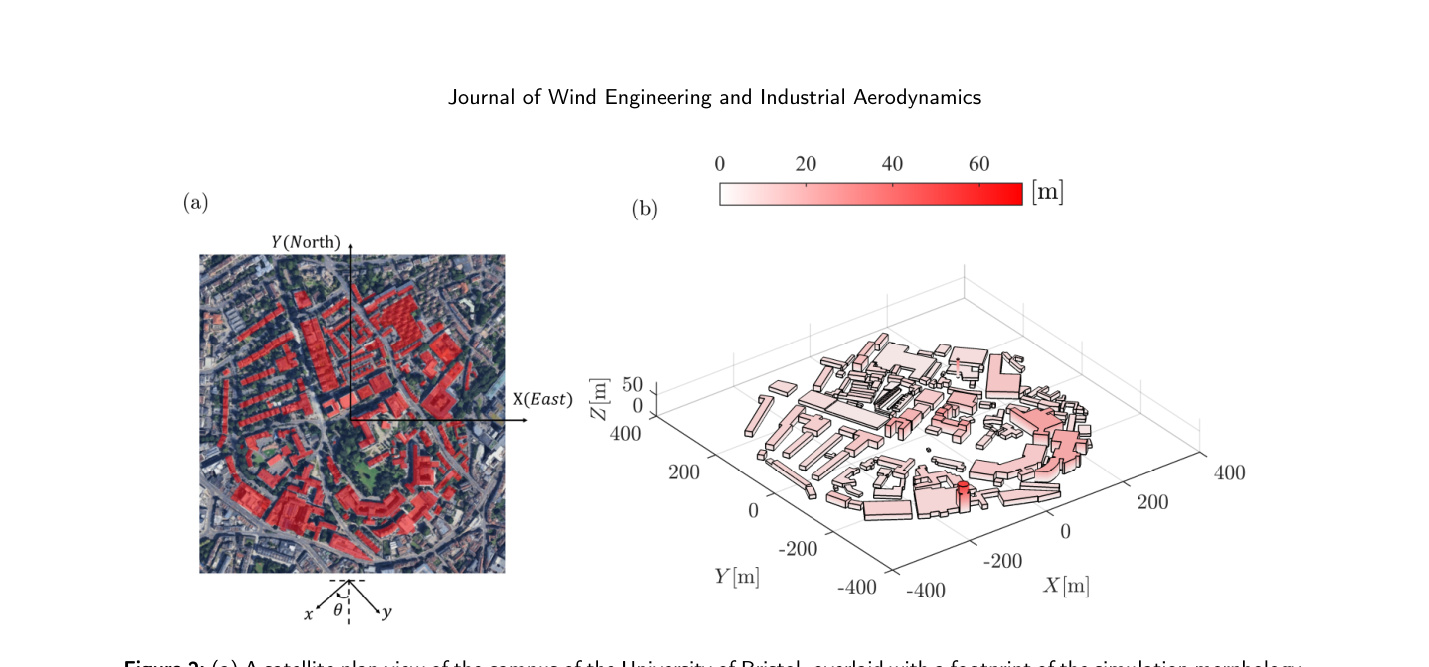
Shielding by upstream buildings is a fundamental control on urban drag, yet its influence remains poorly quantified in realistic urban environments. Here, we investigate shielding effects using building-resolved large-eddy simulations of the University of Bristol campus, comprising 110 buildings of varying height, shape and orientation. Twenty-four wind directions are considered, allowing each building to experience a wide range of upstream shielding conditions. While the total drag of the campus exhibits only moderate directional variability, the drag acting on individual buildings varies substantially. In the present case, approximately of buildings account for of the total drag, which is primarily attributed to a small number of large buildings that contribute disproportionately high drag forces. To quantify shielding, we introduce two dimensionless parameters: the upstream fetch ratio, , and the relative height ratio, , where is the distance to the nearest upstream obstacle, is the height of the upstream obstacle, and is the height of the target building. These parameters distinguish between near- and far-wake conditions and between sheltered and exposed buildings, providing a simple method to characterise shielding effects in realistic urban environments. The study provides valuable quantitative insight into drag and shielding in the Bristol campus morphology; more importantly, it establishes a general framework for analysing drag and shielding that can be applied in other complex urban environments. The results identify shielding as a primary control on building drag and motivate shielding-aware measures of effective frontal area and drag coefficient